Facebook paid creators nearly $3 billion in 2025, and Meta still will not tell you what a single view is worth. That is the honest answer to how much does Facebook pay for views: there is no published rate, and the number on your dashboard moves from month to month. Creators report anywhere from a few cents to about a dollar per 1,000 qualified views, and a small group in valuable niches report more. Meta has announced no 2027 rate card, so any article quoting one is guessing.
This guide gives you the rates creators actually report, the math for every view count from 1,000 to 10 million, the rules that decide which views count, and the bonuses that often pay more than the views themselves.
Key Takeaways
- Meta publishes no fixed rate. Facebook Content Monetization pays on qualified views, and the Earnings Rate in your Professional Dashboard is the only number that matters for your account.
- Most creator reports land between $0.02 and $0.20 per 1,000 views, stronger accounts report $0.30 to $1.20, and a few finance and health outliers with US audiences claim $1 to $5.
- At $0.10 per 1,000 qualified views, one million views pays about $100. At $1.00 it pays about $1,000. Plan with the low number.
- Repeat views, views under five seconds, and content that breaks Meta’s policies earn nothing, and Meta lists twelve reasons a view can fail to qualify.
- Creator Fast Track pays $1,000 or $3,000 a month for three months to eligible creators from other platforms, which can outweigh view income for a long time.
- No one has a 2027 rate. Meta says it will weight original content, watch time, and qualified views more heavily going forward.
How Much Does Facebook Pay for Views? The Short Answer
Facebook pays most creators somewhere between $0.02 and $1.20 per 1,000 qualified views, and the exact figure depends on your content, your audience, and which views Meta counts. There is no flat per-view price. Since Meta folded in-stream ads, Ads on Reels, and the Performance bonus into one program, payouts follow a single performance formula that Meta does not publish.
What Meta Says (and Does Not Say)
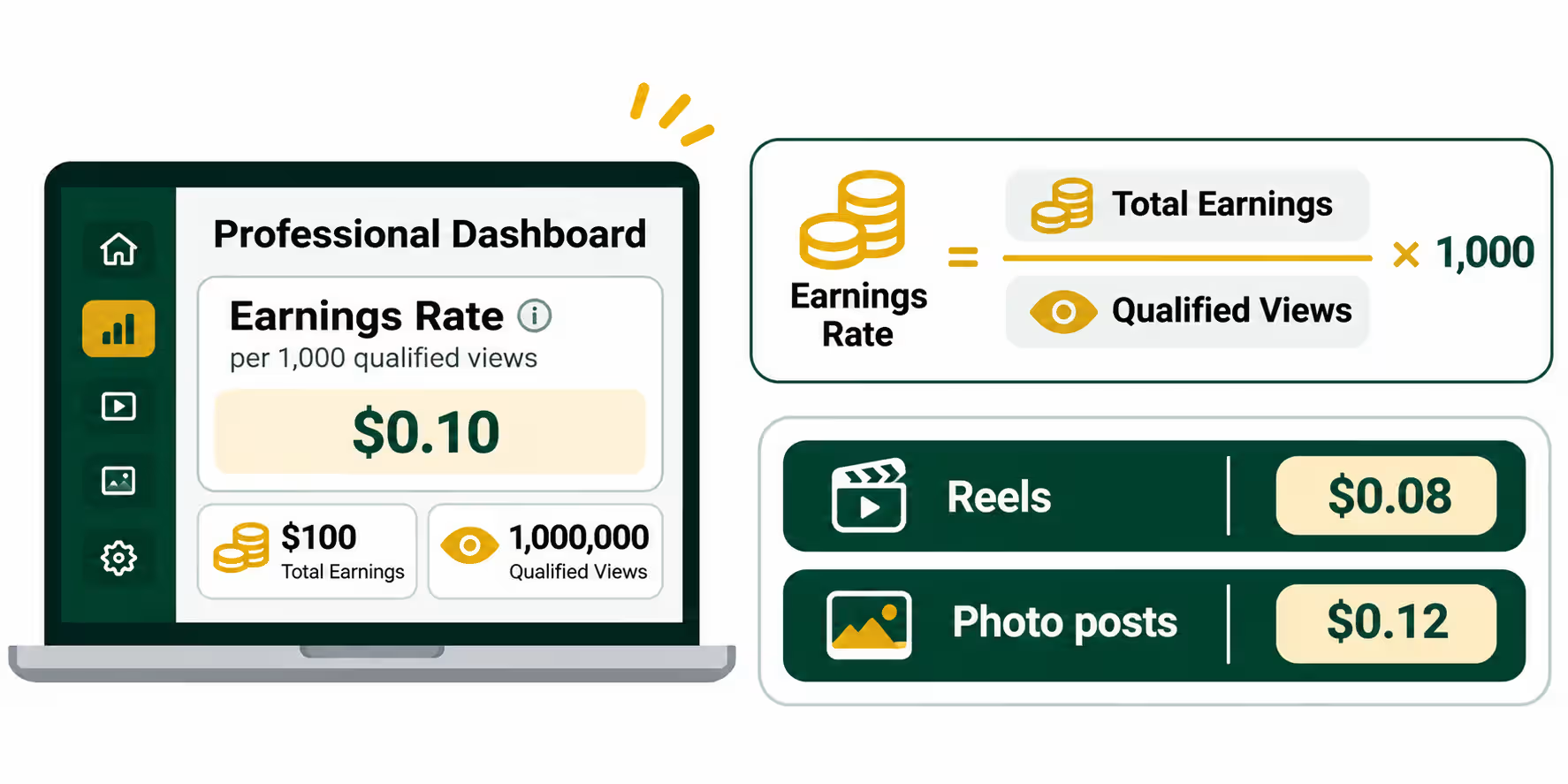
Meta’s own position is narrow. Facebook Content Monetization pays for Reels, longer videos, Stories, photos, and text posts, and your payout depends on the qualified views your content earns. Meta has never put a dollar figure on a thousand of them. What it did add, in March 2026, is a metric called Earnings Rate, which shows your approximate earnings per 1,000 qualified views, plus a breakdown called Non-Qualified Views that explains why some views did not count.
The program is also invite-only. As of November 2026, you request an invite from the Professional Dashboard on the Facebook mobile app: Monetization, then Content Monetization, then the interest form. Meta does not publish a follower minimum, which matters for the next section.
What Creators Actually Report
Because Meta stays silent, the useful data comes from creators who publish their dashboards. Treat these as anecdotes with unknown sample sizes, not official rates.
| Source | Reported rate per 1,000 views | Context |
|---|---|---|
| Insight Hive (creator blog) | About $0.05 to $0.15, working estimate $0.10 per 1,000 qualified views | One creator’s Page, including photo posts that once reached $0.15 |
| Post Bridge (2025 creator survey) | $0.02 to $0.20 | Most creators in the first year of the program |
| Lilach Bullock (calculator guide) | $0.30 to $1.20 | Accounts with mostly US or UK audiences at the top of the range |
| PostPlanify | Up to $1 to $5 | Outliers in finance and health with US audiences |
The pattern is consistent. The middle of the distribution sits in cents, not dollars, and the high numbers belong to accounts that combine a valuable audience with strong retention.
Why Guides Quoting $1 to $10 Per 1,000 Views Mislead
Some popular guides still tell you Facebook pays $1 to $10 per 1,000 views and attach hard requirements such as 10,000 followers and 600,000 watch minutes. Those figures describe the older in-stream ads era, when eligible long videos earned a share of mid-roll ad revenue. Meta replaced that structure with Content Monetization and publishes no follower minimum for the current program, so a guide listing exact thresholds is probably recycling retired rules.
The mistake costs people real money. A creator who budgets $4 per 1,000 views for a Reels strategy and then sees $0.08 on the dashboard has not been underpaid. They were given the wrong number. Use the table above as your range, and replace it with your own Earnings Rate the moment you are accepted.
How Facebook Content Monetization Calculates Your Payout
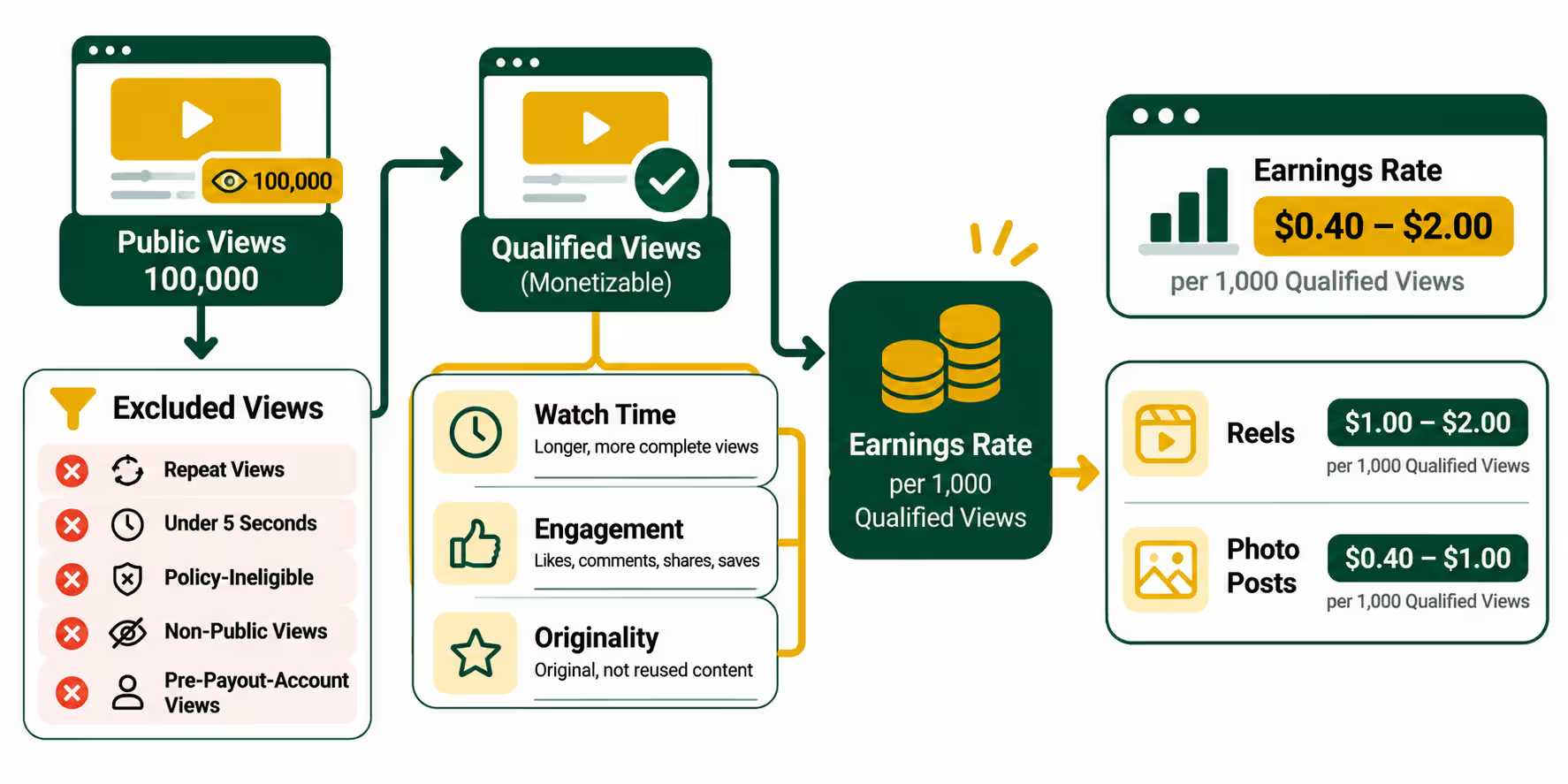
Facebook calculates your payout from qualified views, adjusted by watch time and engagement, and then reports the result back to you as an Earnings Rate. Meta does not reveal the weights. What it has disclosed is enough to explain most of the variation between creators.
Qualified Views Are the Only Views That Pay
Your public view counter and your qualified view count are different numbers. Meta’s March 2026 creator guidance says qualified views exclude repeat views, views shorter than five seconds, and views on content that does not meet its Partner or Content Monetization policies. Third-party summaries add that very short content, non-public posts, and posts published before a payout account is set up also earn nothing.
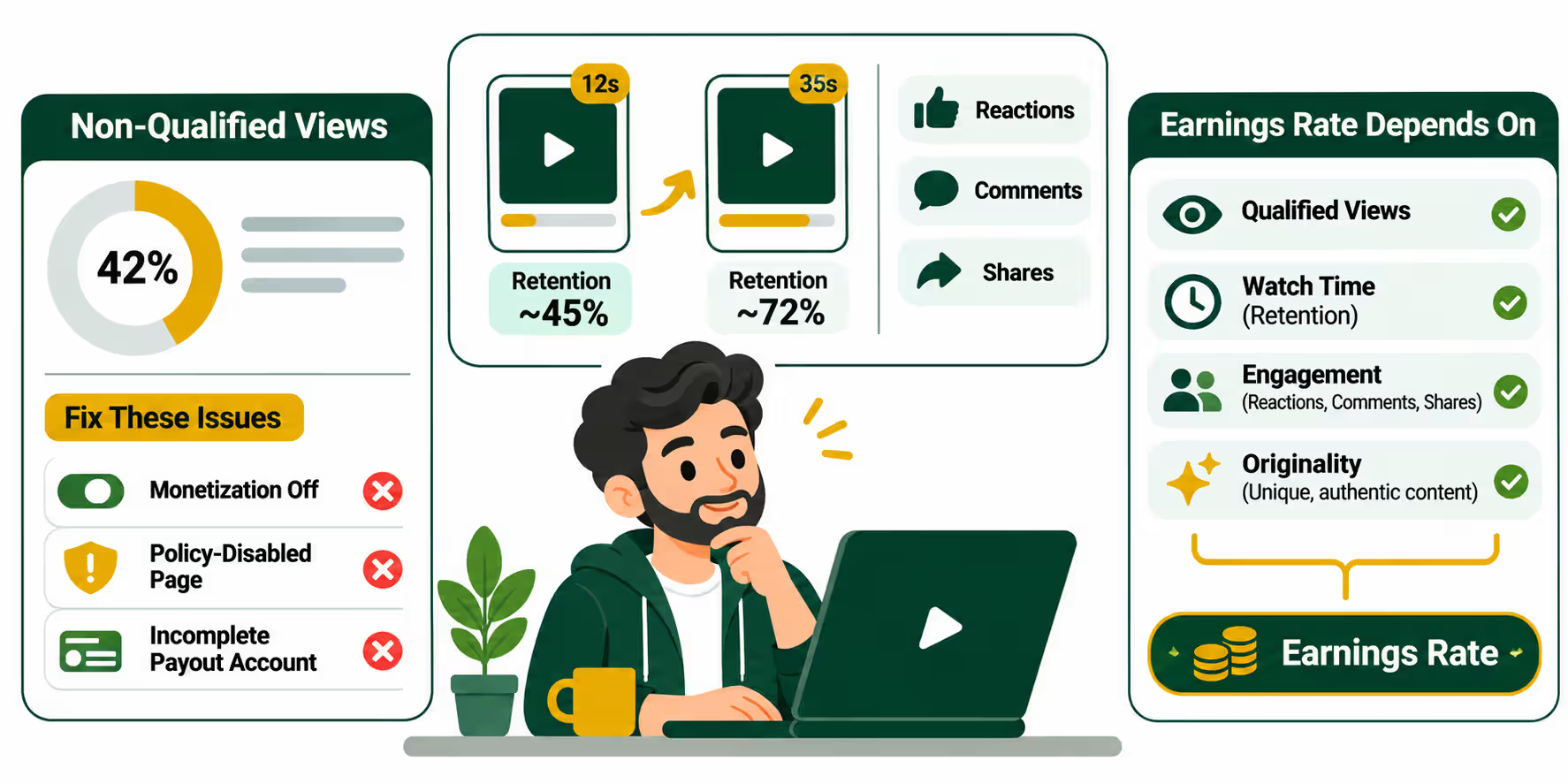
Meta’s dashboard now sorts non-qualified views into twelve categories. Several are fixable by you: monetization switched off on a post, monetization disabled on your Page because of a policy issue, and a payout account that is not fully set up. The last one is the most common and the most painful, because views that arrive while your payout account is incomplete are simply lost.
The practical rule: open the Non-Qualified Views breakdown every week for your first two months. If one category is large, that is your first optimization, ahead of any creative change.
Watch Time, Engagement, and Originality
Meta names three levers that move your payout beyond raw qualified views. Watch time matters because creators may earn more as viewers stay longer on a Reel or Story. Engagement matters because reactions, comments, and shares tell Facebook your content is working, which expands distribution and produces more qualified views. Originality matters because Meta said in March 2026 that it will put even greater emphasis on rewarding original creators for deeper engagement and longer watch time.
The mechanism is worth understanding. Retention drives both reach and rate: a Reel that holds viewers pushes into more feeds, and the same Reel earns more per qualified view than one that loses people at second six. Meta suggests testing different durations to find your sweet spot. In practice that means posting the same idea at 12 seconds and at 35 seconds, then comparing the Earnings Rate for each, not the view count.
Reading Your Earnings Rate
The Earnings Rate in your Professional Dashboard is Meta’s estimate of what you earn per 1,000 qualified views. It is approximate, and it is the only real per-view number you will ever get.
The mistake most people make is dividing total earnings by total views. That produces a number lower than your real rate because it counts views that never qualified. Divide by qualified views instead, or read the Earnings Rate directly. Then track it by format. If your Reels sit at $0.08 and your photo posts at $0.12, you have learned something no guide could tell you.
Facebook Earnings by View Count: 1,000 to 10 Million Views
The table below applies four rates to qualified views. $0.10 is the working estimate one long-running creator uses, $0.50 and $1.00 represent stronger accounts, and $5.00 is the outlier ceiling creators in finance and health report.
| Qualified views | At $0.10 per 1,000 | At $0.50 per 1,000 | At $1.00 per 1,000 | At $5.00 per 1,000 |
|---|---|---|---|---|
| 1,000 | $0.10 | $0.50 | $1 | $5 |
| 10,000 | $1 | $5 | $10 | $50 |
| 100,000 | $10 | $50 | $100 | $500 |
| 1,000,000 | $100 | $500 | $1,000 | $5,000 |
| 10,000,000 | $1,000 | $5,000 | $10,000 | $50,000 |
Worked Example: Total Views Versus Qualified Views
Suppose a Page shows 1 million views in a month. If 70% of those qualify (an assumption for illustration, since your own Non-Qualified Views report will give the true figure), that is 700,000 qualified views. At an Earnings Rate of $0.50, the payout is about $350, not $500. At $0.10 it is about $70.
This is why two creators with identical view counters can report very different income. One has a high qualified share and long retention. The other has lots of repeat views and drop-offs under five seconds.
What It Takes to Earn Real Income From Views Alone
To earn $1,000 a month from views, you need 10 million qualified views at $0.10, 2 million at $0.50, or 1 million at $1.00. Meta reported that the number of creators earning more than $10,000 a year on Facebook grew by over 30% in 2025. That works out to roughly $833 a month, which at a $0.50 rate means about 1.7 million qualified views monthly.
That is achievable for a consistent Page with a viral format, and out of reach for most new accounts. It also explains why Meta now offers guaranteed pay to attract established creators: the per-view economics alone do not recruit anyone.
What Makes Your Facebook Pay Per View Go Up or Down
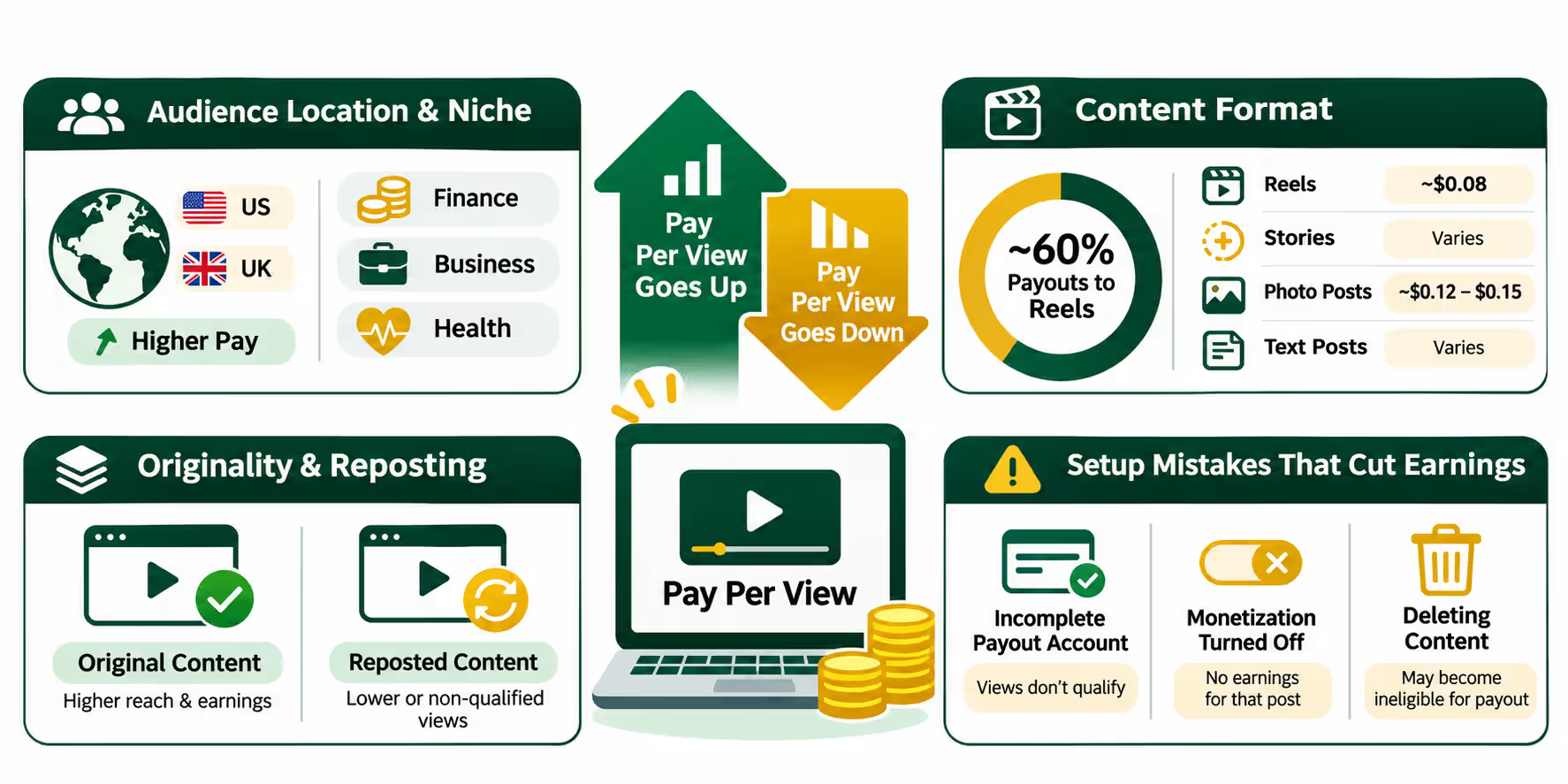
Your pay per view rises with audience value, retention, and originality, and falls with setup errors and repeat or very short views. Meta confirms retention and originality directly. Audience geography and niche come from creator reports, since Meta does not publish them.
Audience Location and Niche
Creators consistently report that US and UK audiences pay more than mixed global audiences, and that finance, business, and health content sits at the top of the range. That fits how advertising works generally: advertisers pay more to reach buyers of valuable products. Entertainment and comedy with a global audience tends to sit at the bottom.
The actionable move is to check your audience location report in Meta Business Suite before you judge a low rate. A Page with 80% of views from low-CPM regions has a ceiling no editing trick will lift. Your options are to shift topics toward what your higher-value viewers respond to, or to accept the lower rate and rely on volume.
Content Format
About 60% of Facebook’s 2025 creator payouts went to Reels, with the rest split across Stories, photos, and text posts. Stories monetization opened globally in March 2025 for creators already in the program, with no view threshold to start earning. Photo posts are not worthless either: the Insight Hive creator reported photo posts reaching $0.15 per 1,000 qualified views at their best.
The lesson is not to abandon Reels. It is to measure each format’s Earnings Rate separately, because a cheap-to-produce photo post at $0.12 can beat an expensive Reel at $0.08 on return per hour worked.
Originality and Reposting
Meta’s stated direction is to reward original creators more. Reposting someone else’s clips, or the same clip across many Pages, is the fastest way to end up with views that do not qualify. One nuance: Meta’s VP of Creator Product, Yair Livne, said Creator Fast Track’s initial posting conditions do not require brand-new content and a back catalog can qualify. That is about meeting the entry conditions of a bonus program, not about how Content Monetization weights your ongoing views.
Setup Mistakes That Quietly Cut Earnings
Three errors account for most avoidable losses. First, publishing before the payout account is complete, which leaves early views non-qualified. Second, leaving monetization toggled off on individual posts. Third, deleting content, because Meta notes that permanently deleted content may become ineligible for payout through the Dashboard. Finish payout and tax setup on day one, before you post anything you hope will perform.
Beyond Views: Fast Track, Breakthrough Bonus, and Payout Rules
For many creators, the guaranteed bonuses are worth more than the view payouts in the first year. They are time-limited and conditional, so treat them as a launch boost, not a salary.
Creator Fast Track
Meta launched Creator Fast Track on March 18, 2026. It pays $1,000 a month to creators with at least 100,000 followers on Instagram, TikTok, or YouTube, and $3,000 a month to creators with more than one million followers on at least one of those platforms. The guaranteed pay runs for three months, and accepted creators get increased reach on eligible Reels and immediate access to Content Monetization without meeting the usual criteria.
The catch is activity. Reporting from Tubefilter says creators must share at least 15 eligible Reels in each 30-day period to earn the monthly amount. Meta’s announcement also mentions bonuses for creators with 20,000 or more followers, so smaller established creators should read the current terms on Meta’s Fast Track page.
Breakthrough Bonus
The Breakthrough bonus is a separate program for US-based adults who have an existing presence on another social app. Meta says accepted creators can earn up to $5,000 in bonuses over their first 90 days, with an individual offer based on an evaluation of their social presence. Applications from creators with at least 20,000 followers on another app are prioritized.
The terms require sharing at least 20 Reels on Facebook and 10 on Instagram in each 30-day bonus period, on at least 10 separate days. Only creators who have not previously monetized on Meta platforms were eligible when it launched, so check the current page before assuming you qualify.
Payout Thresholds and Payment Timing
Payouts run monthly, usually around the 21st to 25th for the previous month’s earnings, according to third-party guides. The minimum balance before money is sent varies by product and country. Meta announced it was lowering the US threshold from $100 to $25, starting with Stars and subscriptions and extending to other products. Some creator guides still list $100 for creators outside the US.
Because sources conflict, check Payouts in your own dashboard for your exact threshold. Balances below the minimum roll over to the next month, so a small account is delayed, not cancelled. Submit tax forms as soon as you are approved, since an unfinished payout account is what holds up first payments.
Stars, Subscriptions, and Brand Deals
Views are only one of Facebook’s income lines. Stars work on public content including Reels, with no minimum view count, and subscriptions let followers pay monthly. Brand deals typically pay far more than the program at the same audience size, which is why the Lilach Bullock calculator guide notes sponsorships usually beat program earnings. Brands that use creators as a channel usually fold this into wider social media marketing and content marketing plans, which makes the view payout a small line item inside a larger budget.
How Much Will Facebook Pay for Views in 2027? What to Plan For
No one can quote a 2027 rate because Meta does not publish one, and every figure you see for next year is an extrapolation. What you can do is plan around the direction Meta has stated and the numbers it has released.
What Is Known and What Nobody Knows
Known: Facebook paid creators nearly $3 billion in 2025, up 35% from the year before, and 60% of that went to Reels. Meta added Earnings Rate and Non-Qualified Views in March 2026 and said it will weight originality, watch time, and qualified views more heavily. Content Monetization remains invite-only as of November 2026.
Not known: the rate per 1,000 qualified views in 2027, whether the invite-only gate opens, and whether the Fast Track bonuses continue. Meta’s 2025 spending suggests it wants creators on the platform, which tends to support payouts, but that is an inference, not a promise.
A Planning Model You Can Trust
Build two scenarios. The conservative case uses $0.10 per 1,000 qualified views. The base case uses $0.50. Once you have a real Earnings Rate from your dashboard, replace both with it. Never build a budget on the $5 outlier, and never count a Fast Track bonus as permanent income.
A Seven-Step Playbook
- Request access. Open the Professional Dashboard on the Facebook mobile app, go to Monetization, then Content Monetization, and complete the interest form.
- Finish payout and tax setup first. Views before this step do not qualify.
- Post original content on a steady schedule. Meta’s own guidance prioritizes original work over reposts.
- Check Non-Qualified Views weekly. Fix the biggest category first.
- Test durations. Post the same idea at two lengths and compare Earnings Rate, not views.
- Apply to Fast Track or Breakthrough bonus if you qualify. Read the current terms and posting minimums before applying.
- Add income that does not depend on views. Stars, subscriptions, and brand deals reduce the damage if the rate drops.
Conclusion
So, how much does Facebook pay for views? Plan on cents per 1,000 qualified views for a typical account, dollars for rare high-value niches, and a rate that only your own Earnings Rate can confirm. The 2027 number does not exist yet, which is the reason to build your plan on conservative math and a mix of income sources. Start by requesting access through the Professional Dashboard and finishing your payout setup this week, then check your Non-Qualified Views report after your first month of posts.
Frequently Asked Questions
How much does Facebook pay per 1,000 views?
Meta publishes no fixed rate. Creator reports cluster between $0.02 and $0.20 per 1,000 qualified views for most accounts, $0.30 to $1.20 for stronger ones, and $1 to $5 for rare high-value niches. Your Earnings Rate in the Professional Dashboard shows your own figure.
How much does Facebook pay for 1 million views?
At typical creator-reported rates, one million qualified views pays roughly $20 to $200, and up to $1,200 for stronger accounts. The total depends on how many of your views qualify, so a Page showing a million views may be paid on fewer.
How much does Facebook pay for 100,000 views?
At $0.10 per 1,000 qualified views, 100,000 views earns about $10. At $0.50 it earns about $50, and at $1.00 it earns about $100. Fewer views than that qualify if many were repeats or under five seconds.
What are qualified views on Facebook?
Qualified views are the views that count toward your Content Monetization payout. Meta excludes repeat views, views shorter than five seconds, and views on content that does not meet its Partner or Content Monetization Policies. Your dashboard shows both qualified and non-qualified views.
How many followers do you need to get paid by Facebook?
Meta does not publish a follower minimum for Facebook Content Monetization, which is invite-only as of November 2026. You request an invite through the Professional Dashboard. Creator Fast Track accepts creators with at least 100,000 followers on another platform for its guaranteed pay.
Does Facebook pay for Reels, photos, and text posts?
Yes. Facebook Content Monetization pays for Reels, longer videos, Stories, photos, and text posts. About 60% of 2025 payouts went to Reels, with the rest split across the other formats, according to Meta.
How do I find my Facebook Earnings Rate?
Open the Professional Dashboard on the Facebook mobile app and look at your Content Monetization insights. Meta added Earnings Rate in March 2026, and it shows your approximate earnings per 1,000 qualified views.
When does Facebook pay creators?
Facebook pays monthly, usually around the 21st to 25th for the previous month’s earnings, according to third-party guides. Your balance must reach the minimum threshold for your product and country, and smaller balances roll over to the next month.
Is the Facebook Reels Play bonus still available?
No. The old Reels Play bonus has been retired. Facebook Content Monetization replaced it, along with in-stream ads, Ads on Reels, and the Performance bonus, in one unified program.
Why are my Facebook views high but my earnings low?
The usual cause is a low qualified-view share or a low Earnings Rate. Repeat views, drop-offs under five seconds, an unfinished payout account, or an audience in lower-value regions all reduce what you are paid. Check the Non-Qualified Views breakdown first.
What is Facebook Creator Fast Track?
Creator Fast Track is a Meta program launched in March 2026 that pays $1,000 a month to creators with at least 100,000 followers on Instagram, TikTok, or YouTube, and $3,000 a month to those with over one million. Pay is guaranteed for three months and comes with increased reach and access to Content Monetization.
Will Facebook pay more per view in 2027?
No one knows, because Meta does not publish rates. Meta has said it will put more weight on original content, watch time, and qualified views, and creator payouts rose 35% in 2025. Those signals favor strong creators, but they do not guarantee a higher rate per 1,000 views.